

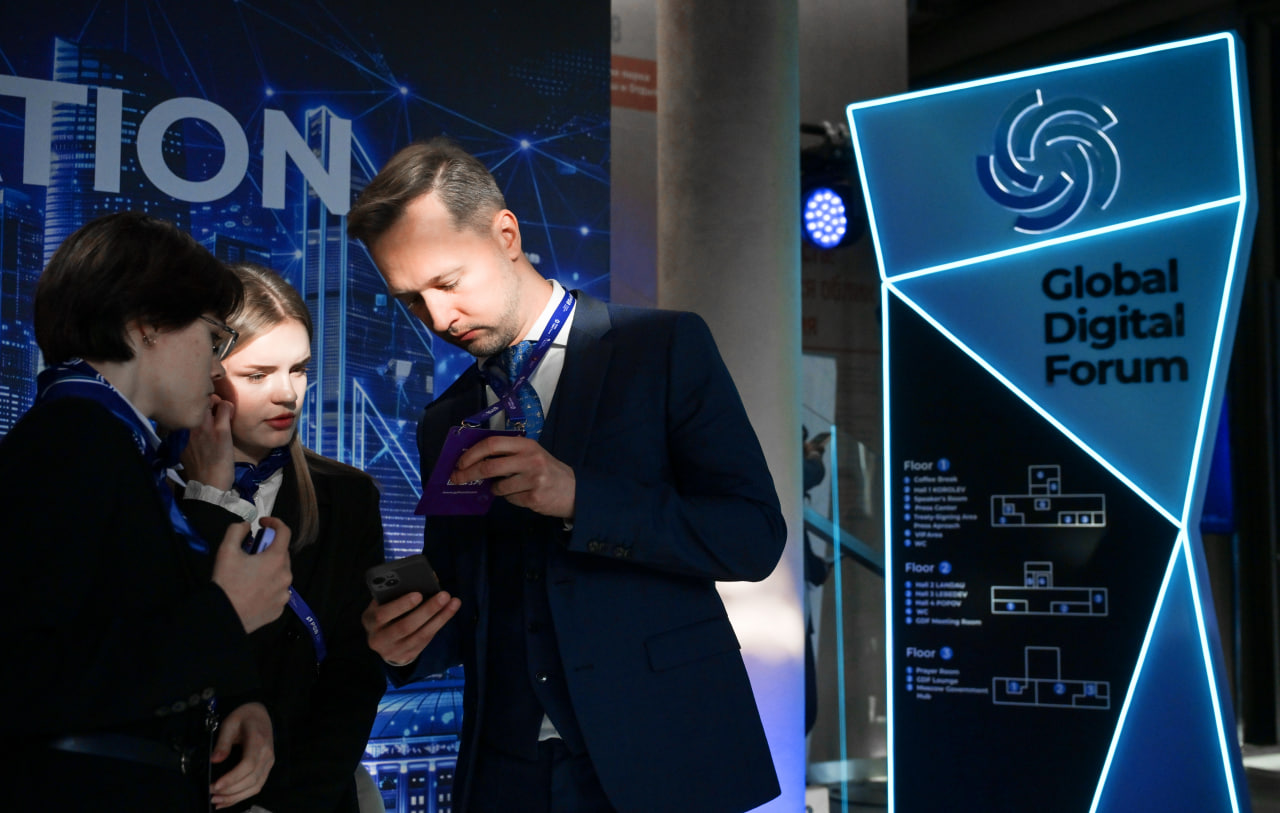
One of the highlights of the forum’s second day was the plenary session “Digital Sovereignty: From Resource to Export Asset,” during which First Deputy Chief of Staff of the Presidential Executive Office Sergey Kirienko emphasized that Russia remains open to foreign companies.
“Just one condition – respect the laws, culture, traditions, and people of the country. If you accept these rules, we welcome your presence in the Russian market,” he said.
During the masterclass “High-Tech Market Rules: Strategies for the International Growth of Technology Companies,” experts shared strategies for scaling technology businesses. They emphasized that successful expansion into international markets requires a thorough understanding of target audiences, local cultural norms, and country-specific legal requirements.
The session “AI-sation As Smart City Trend” explored the evolving digital landscape of modern cities. Participants discussed real-world examples of AI assistants being deployed in urban environments and opportunities to expand their use.
Anton Zubkov, Head of Project Support at the Official Portal of the Mayor and the Government of Moscow, Moscow Department of Information Technologies, spoke about the Moscow digital assistant. He noted that the service is more than just a standalone chatbot: it serves as a unified intelligent interface connecting residents with the city’s digital ecosystem.
“AI helps change the logic and language of interaction between people and the authorities. When engaging with the authorities, people need to know which service they need, which is where AI helps us simplify this complicated formal interaction,” Anton Zubkov said.
During a session on healthcare digitalization, experts explored how artificial intelligence, big data, and telemedicine can help identify health risks at an early stage. Rustam Yerizhokov, Head of the Research Department for Standardization and Quality Control at the Center for Diagnostics and Telemedicine, shared insights on the use of AI in Russian healthcare. He described a six-year experiment in Moscow showing how technology and artificial intelligence can help doctors interpret diagnostic studies faster. Over that period, AI tools were tested across more than 45 clinical specialties.
“We have even seen the emergence of mandatory specialized insurance protocols that incorporate the use of artificial intelligence by physicians,” Yerizhokov reported.
At the masterclass “Govtech: How to Build a National Services Platform,” experts examined two examples of digital government platforms: Russia’s Gosuslugi [Public Services] portal and the Philippines’ eGovPH app, which has been downloaded 60 million times and has processed more than 900 million transactions.
Sergey Tsvetkov, Deputy Minister of Digital Development, Communications, and Mass Media of the Russian Federation, spoke in greater detail about how the Gosuslugi portal operates and its distinctive features. He noted that the Gosuslugi portal integrates numerous information systems and offers citizens digital services in virtually all aspects of life. Today, 120 million users are registered on the platform.
During the panel discussion “National Code Without Borders: Exporting Art, Technology, and Media,” participants said that Russian IT companies can offer international markets solutions that help safeguard technological sovereignty and preserve cultural heritage.
Andrey Samchenko, Director of International Strategic Projects at Positive Technologies, highlighted Russia’s strong cybersecurity expertise, which has gained international recognition and is in demand worldwide.
He attributed this strength to the high level of professional training, a solid engineering tradition, and the ability to develop unconventional solutions.
Speaking at the forum, Russian Foreign Ministry Spokeswoman Maria Zakharova warned that treating artificial intelligence recklessly could ultimately erase human individuality. “Toying with AI could erase human individuality. Everything that makes each person unique and irreplaceable would be completely erased,” Zakharova said.
Speaking at the panel discussion “The Next Computing Frontier: The Quantum Era,” Director of Quantum Technologies at Rosatom State Corporation Ekaterina Solntseva highlighted the potential of quantum technologies to drive the next wave of technological development.
During the panel discussion “Telecom Infrastructure: Demands and Solutions. Global Experience,” Denis Shershnev, Director of the Department for International Telecom Operators and Content Providers at Rostelecom, presented the TEA Next trans-Eurasian fiber-optic network project, which is expected to become the world’s longest terrestrial fiber-optic cable.
“The infrastructure we are building today will have a lasting impact on the country’s economy and telecommunications network. I cannot recall another project of this magnitude being undertaken in Russia in recent decades,” he said.
The impact of artificial intelligence on workforce training was explored during the session “Rectors’ Club: Education by New Rules. Staying Ahead of AI Trends.”
Rector of Skolkovo Institute of Science and Technology (Skoltech) Yulia Gorbunova believes that AI is a tool that students should learn to use from an early age, while continuing to study main traditional subjects.
“The fundamentals must remain unchanged. The advent of artificial intelligence has not altered the basic laws of mathematics, physics, or chemistry, and students must continue to learn these subjects,” Gorbunova said.
During the session “Global Dialogue on AI Ethics: Expert Forum on New Challenges,” experts explored ways to ensure that humans remain in control of artificial intelligence.
Jimena Sofia Viveros Alvarez, Deputy Chair of the International Law Association’s Committee on AI and Technology Law, emphasized that advancing AI requires not so much developing new ethical principles as putting them into practice. She pointed to UNESCO’s recommendations on AI ethics, adopted by 190 countries, as an example and stressed the importance of monitoring how these principles are implemented across different countries and legal systems.
“We need to exchange experiences, definitions, and concepts. We need common institutions, diverse perspectives, and widely recognized principles that we can share so that we can move forward together toward a common goal,” she added.
During a session held with the support of the Russian Foreign Ministry, participants discussed the work of the UN’s Global Mechanism on ICT Security.
Andrey Akulchev, Acting Director of the Department of International Information Security at the Russian Foreign Ministry, noted a troubling trend: while artificial intelligence has become a valuable tool, it is also increasingly being exploited for malicious purposes.
“Regrettably, we must acknowledge that the international information security situation is deteriorating year by year – or even day by day, I would say,” he emphasized.
The Global Digital Forum 2026 is taking place from October 8 to 10 at the Mechta complex in Gorky Park in Moscow. It has brought together delegates from 120 countries in Africa, Asia, the Gulf region, Latin America, and Europe. The Forum is held with the support of the Russian Government, the Ministry of Digital Development, and the Russian Foreign Ministry. Forum partners include the Moscow Government (General Partner), Bank PSB Public Joint-Stock Company (Strategic Partner), А7 Russian International Settlement System (Special Partner), VKontakte (Official Partner), Roscosmos and the TsNIIMash rocket and spacecraft scientific center (Space Partners), Rostelecom (Technology Partner), RIA Novosti (General Media Partner), and Kommersant Publishing House (General Information Partner). Other forum partners are Russian companies Positive Technologies, Ruwiki, Signaltec, TData and Petroglyph. The forum is operated by National Priorities and NPO Center for Global IT-Cooperation.