

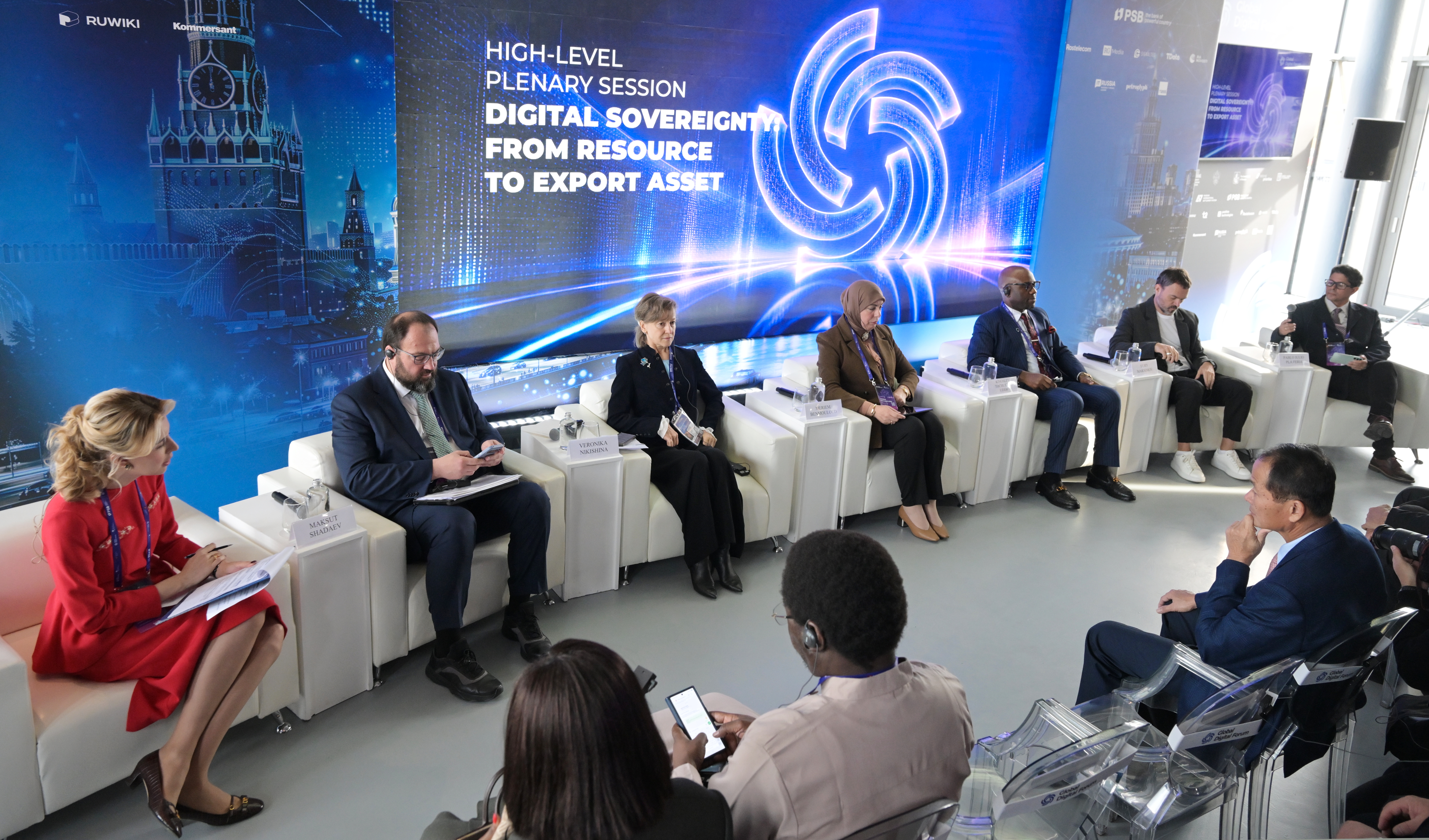
Russia remains open to all foreign companies, stated Sergey Kirienko, First Deputy Chief of Staff of the Russian Presidential Executive Office, while speaking at the high-level plenary session, Digital Sovereignty: From Resource to Export Asset, at the Global Digital Forum.
“Just one condition – respect the laws, culture, traditions, and people of the country. If you accept these rules, we welcome your presence in the Russian market,” he emphasized.
Sergey Kirienko also noted that over recent years, Russia has built a comprehensive system of its digital sovereignty. “One important point – we are absolutely open not just to sharing our experience, but to passing it on,” he added.
He further stated that Russia is ready to become a full-fledged partner for other countries in the realm of digital technologies, not by imposing its solutions, but by helping to create a robust domestic industry and ensure the digital sovereignty of partner states.
Sergey Kirienko also noted that the strains on the international legal system have shown that there are no longer any guarantees that national rights will be respected or that a specific country’s interests will be taken into account.
“It has become clear that, in reality, there are no guarantees that a specific country’s rights will be respected, nor are there any guarantees that decisions will always be made objectively and fairly with the interests of every participant in the global market taken into account – instead, we see an endless number of sanctions. Russia is a prime example; we are navigating this challenge ourselves,” said the First Deputy Chief of Staff of the Presidential Executive Office.
He added that any state today could face such challenges. “There are no limits on the application of sanctions – this has already been demonstrated with absolute certainty – and there are no limits on unjustified interference in your internal affairs. If you do not protect yourselves, no one else will protect you,” he emphasized.
According to Sergey Kirienko, the question of digital sovereignty became fundamentally important relatively recently – over the past four to five years. This is tied to the growing influence of digital technologies and the cost of making an error, which “is becoming ever more severe.”
Other participants in the session also shared their experiences in building digital infrastructure under external pressure. Pablo Julio Pla Feria, Deputy Minister of Communications of the Republic of Cuba, reported that the country has developed its own artificial intelligence infrastructure by bringing organizations together to create new technologies.
He noted that the digital architecture for government services created under severe pressure can be adapted and offered to other countries seeking to ensure digital sovereignty across all government operations.
He also highlighted that digital government resources facilitate access to public services for more than 400,000 Cubans, and that the national AI consortium already includes 23 organizations, spanning government agencies, academic institutions, and private companies.
Algeria is also actively developing its digital and technological sovereignty and achieving significant success in this area, stated Meriem Benmouloud, Minister of Digitization and Statistics of the People’s Democratic Republic of Algeria.
She emphasized that the country has the second-largest economy on the African continent by GDP, and as a result, it can provide the necessary infrastructure and build data centers and technology hubs to ensure resilient connectivity between Europe and Africa.
“Today, we are working not only to establish resilient connectivity within the country but also to collaborate with external parties by establishing reliable connections with partners, including laying and installing reliable subsea cables. We believe that Algeria, given its proximity to Europe and its location in North Africa, serves as a vital link between the two continents and can therefore become a crucial bridge in terms of connectivity,” said Meriem Benmouloud.
Meanwhile, Veronika Nikishina, Chief Executive Officer of the Russian Export Center, stated that Russia’s digital sovereignty is becoming the foundation for global exports.
She noted that Russia boasts a mature portfolio of digital solutions across five key areas: cybersecurity, smart cities and urban infrastructure, housing and utility services, citizen services, and technologies for healthcare, agriculture, and unmanned systems.
In her view, sovereignty is not about isolation but rather the complementarity of solutions in areas where Russia is already unequivocally a leader.
Yandex’s products are a prime example of the successful export of Russian digital solutions, said Perko Matović, State Secretary of the Ministry of Information and Telecommunications of Serbia.
He noted that although Serbia has created a level playing field for free competition and does not permit discrimination, the company’s products have become the most popular services in a wide range of areas, including navigation.
“Let me share a Russian example that will be very interesting to you. Yandex competed with all the major global players in Serbia and beat them,” emphasized Perko Matović.