

Quantum technologies are emerging as one of the most promising fields of the next technological era. Quantum computing, communications, and sensing are now advancing rapidly, with technological and industrial ecosystems taking shape around them.
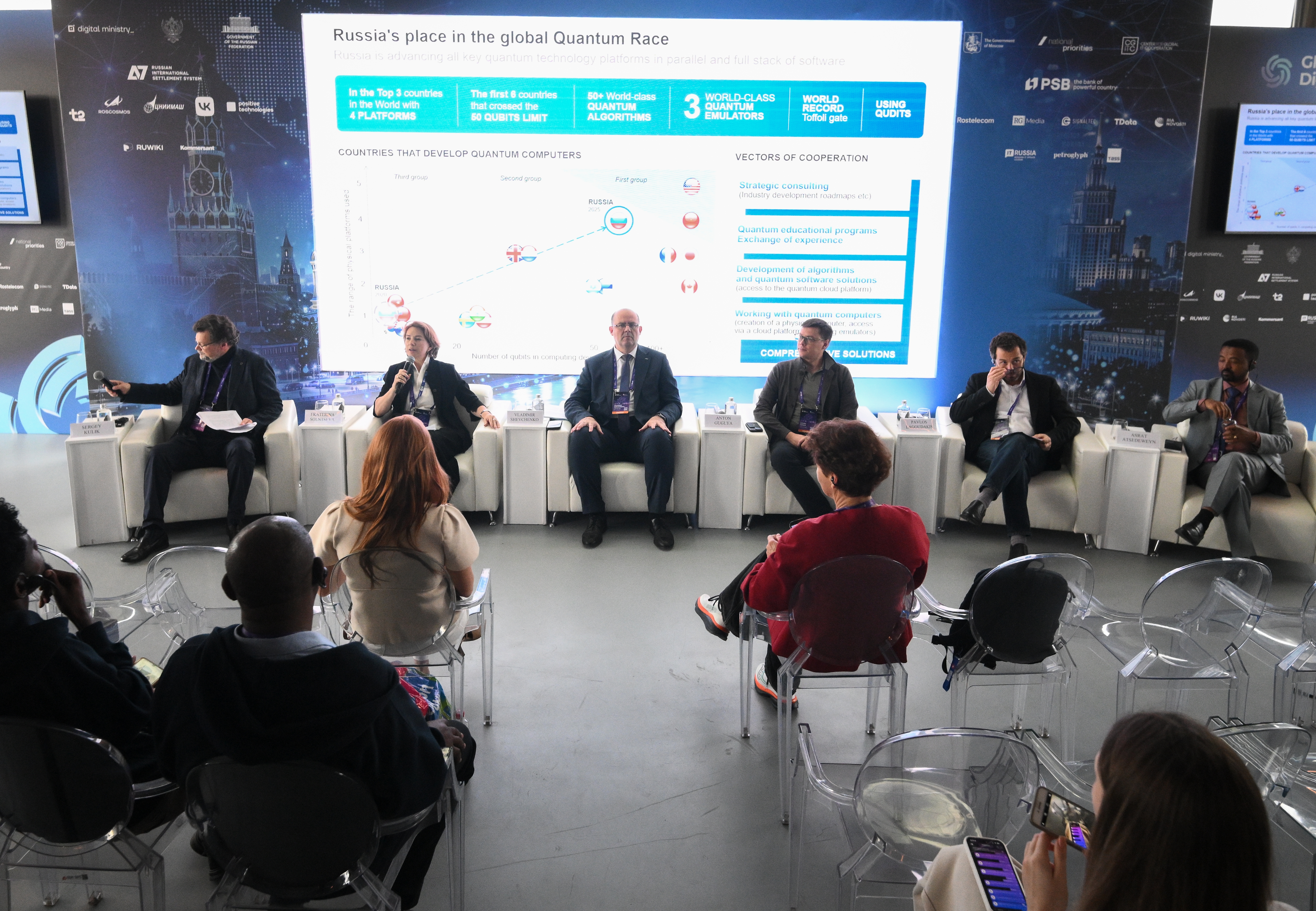
At a panel discussion titled “The Next Frontier of Computing: The Quantum Era,” experts explored which areas of quantum technology hold the greatest potential for practical applications and national technological development, as well as ways to combine fundamental research with applied quantum programs.
Director of Quantum Technologies at Rosatom State Corporation Yekaterina Solntseva noted that Russia has historically had a strong foundation in quantum physics. She also explained what quantum technologies are and why countries around the world are striving to make breakthroughs in this field.
“We have seen how computerization has transformed economies around the world. Today, we are witnessing the growing use of artificial intelligence. We believe the next major technological leap will be driven by quantum technologies. The development of these technologies will play a major role in determining countries’ competitiveness,” Solntseva said.
She also emphasized that quantum communications will make it possible to transmit data securely, bringing the risk of interception or hacking during transmission close to zero.
“Quantum sensing will make it possible to measure physical, magnetic, and gravitational values with up to a thousand times greater precision, paving the way for innovative approaches to navigation, logistics, and medicine. Quantum technologies will affect virtually every aspect of life,” Yekaterina Solntseva noted.
CEO of QApp Anton Guglya said Rosatom’s efforts made it possible to boost the quantum computers’ computing power in Russia every year.
“In addition to quantum computers, industry-specific algorithms are being developed as well. Pilot projects are already using such algorithms to solve problems in finance, investment, and retail business,” Guglya said.
Rector of the National Research Nuclear University MEPhI Vladimir Shevchenko noted that Russia’s Quantum University brings together five of the country’s leading universities. This inter-university research and educational initiative is designed to train specialists for Russia’s quantum technology sector. “We look forward to this initiative becoming international during the next phase,” Vladimir Shevchenko said. “We already have a roadmap in place.”
Academic Secretary, First Vice-Rector, and Head of the Hybrid Photonics Laboratory at the Skolkovo Institute of Science and Technology (Skoltech) Pavlos Lagoudakis underscored that it is difficult to predict which fundamental science discoveries will give rise to breakthrough technologies.
“We need to find an answer to the question of what fundamental science needs in order for research to yield specific technologies. It is possible to create a system to support this process. Fundamental science needs support, and it will then make more discoveries,” Lagoudakis said.