

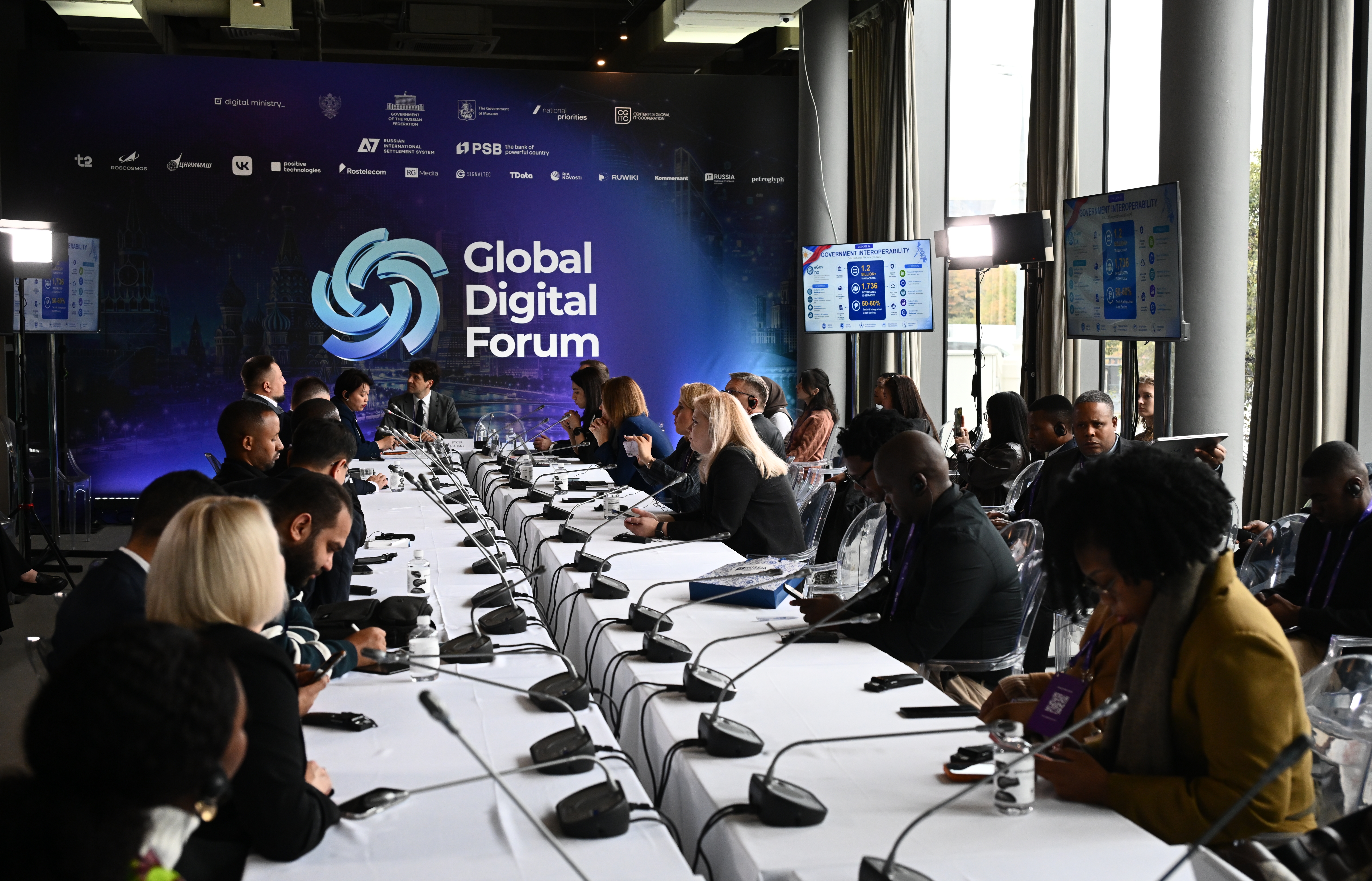
In Russia, the majority of the adult population uses the Gosuslugi [Public Services] portal. In the Philippines, the equivalent service is eGovPH, which has garnered 60 million downloads and has processed more than 900 million transactions. During the session, Master Class. Govtech: How To Build A National Services Platform, participants conducted a practical analysis of two case studies: the Russian and Philippine portals for delivering public services.
“We are discussing the digital transformation of the government and, in particular, the Gosuslugi platform; the development of digital platforms; data exchange; and the application of all technologies, first and foremost, artificial intelligence,” noted Pyotr Ototsky, Deputy Director of the Digital School of Public Administration Center at the Presidential Academy (RANEPA).
Sergey Tsvetkov, Deputy Minister of Digital Development, Communications, and Mass Media of the Russian Federation, spoke in greater detail about how the Gosuslugi portal operates and its distinctive features. He noted that the Gosuslugi portal integrates numerous information systems and offers citizens digital services in virtually all aspects of life. Today, 120 million users are registered on the platform.
He also devoted part of his remarks to the development of a unified digital identification system in Russia. This system allows citizens to log into government portals and commercial platforms using a single account. In addition, the deputy minister outlined the system’s future development priorities.
“The goal for 2030–2035 is for every user to authenticate any action they take using biometrics, because this is the most reliable method, unlike a username and password,” he added.
Sergey Tsvetkov also noted that data exchange between government agencies remains one of the persistent challenges of digitalization.
Meanwhile, Geraldine T. Bucog, Officer-in-Charge, Director IV, of the Government Digital Transformation Bureau at the Department of Information and Communications Technology (DICT), spoke about the distinctive features of the Philippine eGovPH platform.
She explained that the digital platform allows citizens to access services in various sectors, including healthcare, education, and employment. An AI-based virtual assistant is also being developed to improve access to these services.
Geraldine T. Bucog also addressed data exchange between government agencies and the centralization of IT infrastructure. The data exchange platform helps reduce paperwork, while the reuse of shared digital solutions helps lower government costs.
Drawing on the speakers’ remarks, Pyotr Ototsky noted that the two countries are moving in roughly the same direction and at roughly the same pace. He proposed continuing to share best practices in this area.