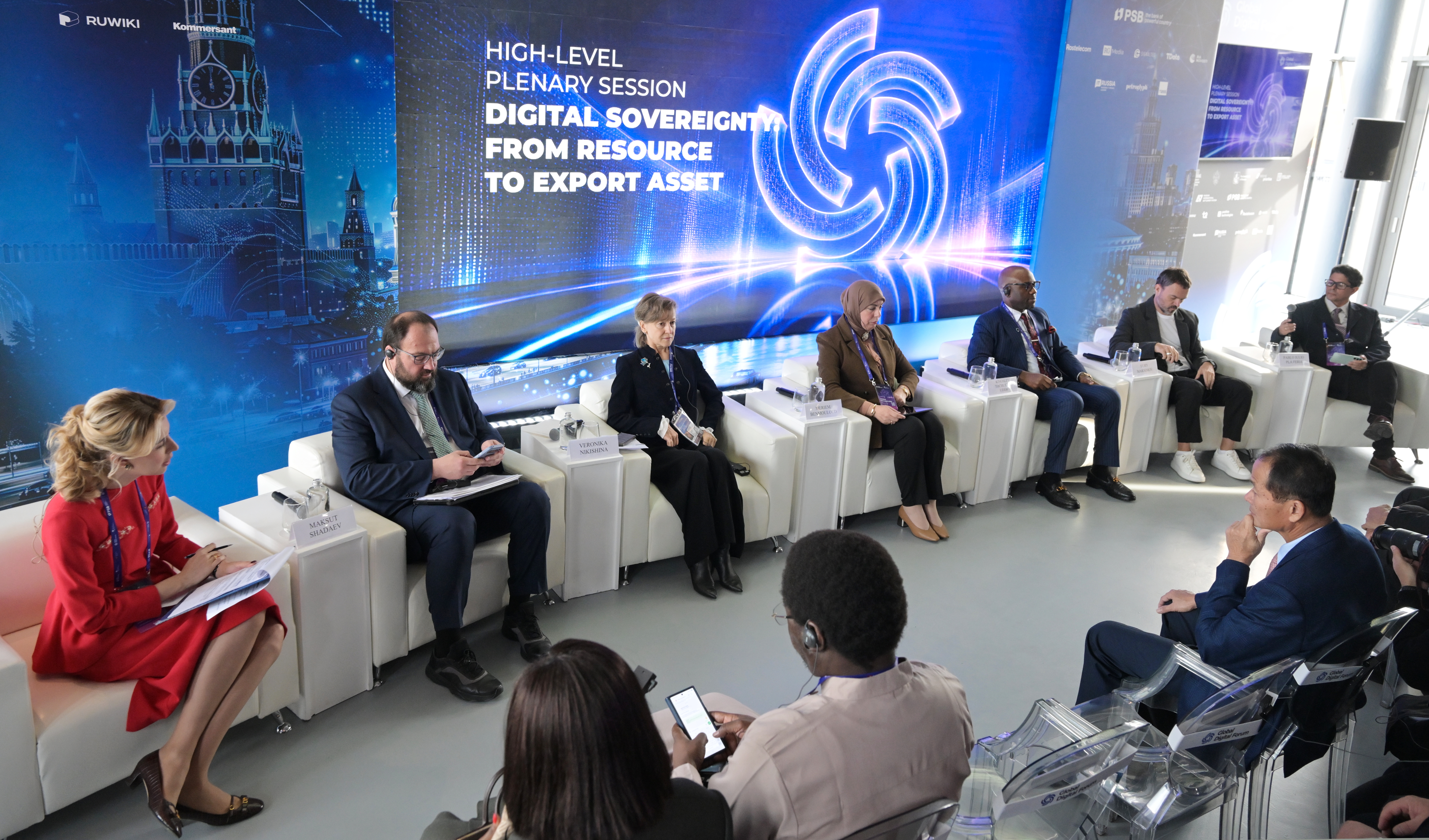



Experts explored key priorities for telecommunications development and major infrastructure projects during a panel discussion titled “Telecom Infrastructure: Demands and Solutions. Global Experience.”
Denis Shershnev, Director of the Department for International Telecom Operators and Content Providers at Rostelecom, spoke about the trans-Eurasian fiber-optic network. The TEA Next terrestrial cable project, currently under development in Russia, is designed to provide an alternative to subsea cables, creating the shortest digital route connecting Central and Northeast China with Europe.
The project has been underway since the summer of 2020. The fiber-optic line stretches from Russia’s western to eastern borders, with connections extending to the borders with Mongolia and China.
“The infrastructure we are building today will have a lasting impact on the country’s economy and telecommunications network. I cannot recall another project of this magnitude being undertaken in Russia in recent decades,” Denis Shershnev said, adding that TEA Next will become the world’s longest terrestrial fiber-optic cable.
Konstantin Novikov, Head of Sales to National Telecom Operators and Content Providers at MegaFon, highlighted the growing number of connected devices in individual households as a key factor shaping user expectations.
“The idea of ‘one gigabit for every apartment’ has already come up at the forum. What matters is ensuring that every device in a household has a reliable, high-speed connection, with smooth content delivery and minimal latency,” he emphasized. Olga Makarova, Director of the Commercial Resource Management Department at MTS, said the company is currently focused on deploying high-speed network equipment.
“Our network currently uses equipment supporting speeds of 400 Mbps. We are testing 800 Mbps systems and evaluating 1.6 Tbps technology. That is our first priority. The second is expanding our fiber-optic infrastructure, both by making use of existing fiber and laying new cables along the most heavily used routes,” she explained.
Viktor Aguila Ramírez, Ecuador’s Vice Minister of Telecommunications, said that Latin American countries are exploring alternatives to fiber-optic connectivity, particularly satellite technologies.
“As part of a government initiative in Ecuador, we deployed approximately 1,000 free internet access points in remote areas, giving residents access to telemedicine and educational services,” he said.
Nkundwe Moses Mwasaga, Director General of the Tanzania Information and Communication Technologies Commission, emphasized the need to modernize the country’s telecommunications infrastructure to drive growth across multiple sectors of the economy and increase GDP.
“We need more subsea cables and a more extensive backbone network across Africa. Demand is growing, and this creates new opportunities for Russian investors,” the expert believes.