

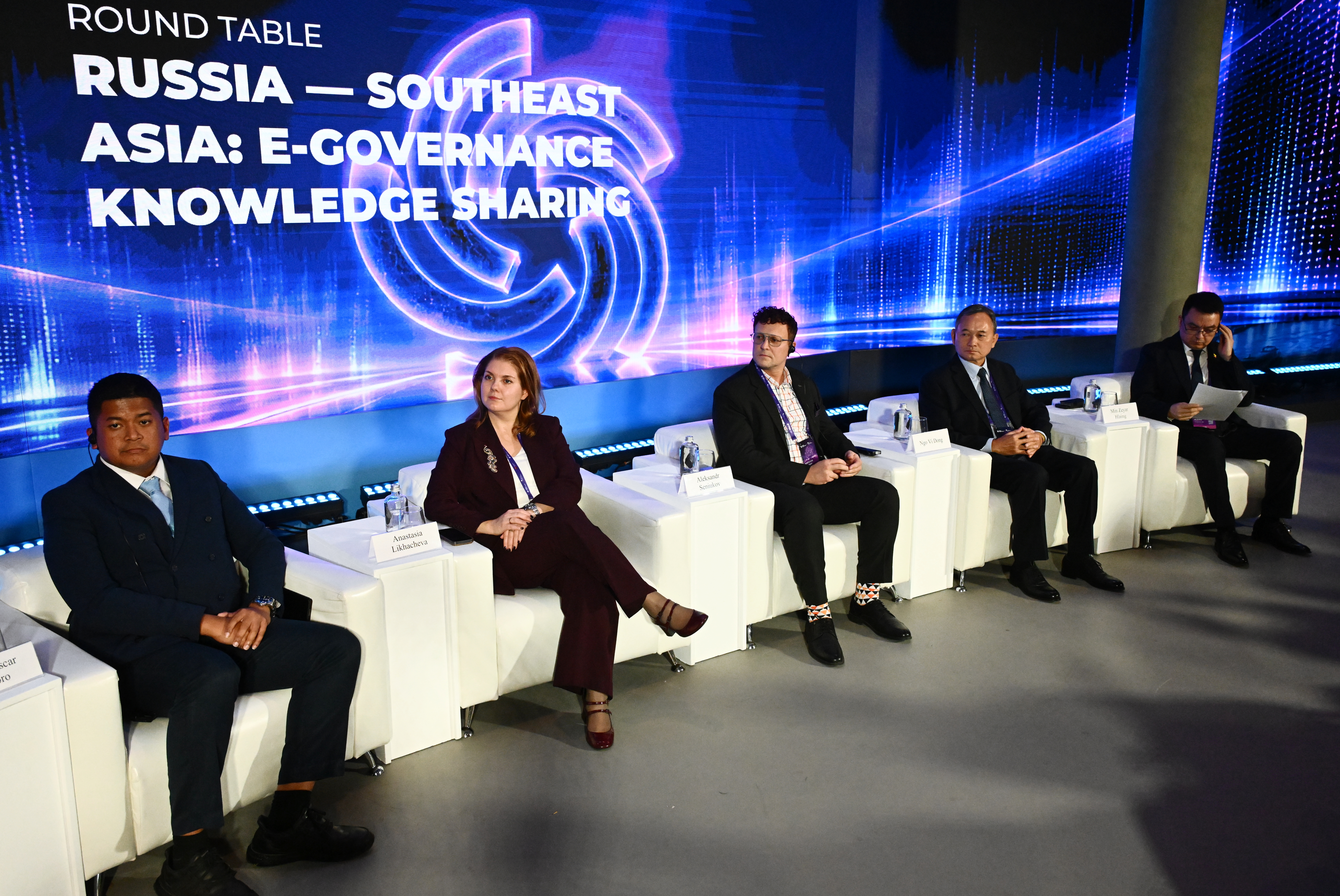
Participants from Russia, Indonesia, Myanmar and Vietnam discussed ways to establish an ongoing exchange of knowledge, spanning educational programs and joint pilot projects. The discussion took place at a roundtable titled Russia – Southeast Asia: E-Governance Knowledge Sharing.
Anastasia Likhacheva, Dean of the Faculty of World Economy and International Affairs at the National Research University Higher School of Economics, noted that a key competitive advantage of Russian companies is their ability to offer solutions that partner countries can fully adopt, master, adapt, and further develop. She also singled out cybersecurity as a priority for Russia.
“We live in a world where no system can be made entirely immune to attack. Identifying vulnerabilities and restoring systems quickly are our foremost priorities," she added.
U Min Zeyar Hlaing, Deputy Minister of Digital Development and Communications of the Republic of the Union of Myanmar, also highlighted cybersecurity and personal data protection as promising areas for cooperation with Russia.
“Russia has considerable expertise in this field. We would also welcome the opportunity to work with Russia on personal data protection,” he said.
Alexander Senyukov, Deputy Director General for Government Relations at T8, emphasized that Russia develops its own digital services rather than purchasing them from abroad, noting that this experience could be valuable to other countries.
“Indonesia is a good example of what we have achieved: pilot projects are already underway, with network traffic and data transmitted over our equipment. We take great pride in this, and I hope to see similar developments with other Southeast Asian countries before long,” he said.
Ngo Vi Dong, Board Chairman of HPT Viet Nam Corporation, who was educated in the Soviet Union, began his remarks by reflecting on how his education had taught him to think systematically.
“My Soviet education made me stronger, more disciplined, and more dedicated to my work. And I’m not talking only about technical matters – I understand Russian culture, and I understand Russia,” he said.
According to Ngo Vi Dong, Russia should further expand its cooperation with Vietnam and enhance its presence in the country.
“Russia is the best partner. We are eager to work with Russian companies. Come to Vietnam and build a long-term partnership with our country,” he said.
The roundtable participants agreed that the digital transformation of public administration requires more than technology alone: it also depends on a skilled workforce, reliable infrastructure, cyber resilience, and advanced approaches to data governance. Russia is keen to learn from Southeast Asia’s experience in regional digital cooperation, cross-border payments, and adapting services to different local contexts. Southeast Asian countries, in turn, are interested in Russian expertise in developing public services, digital identification, and platform-based solutions.