

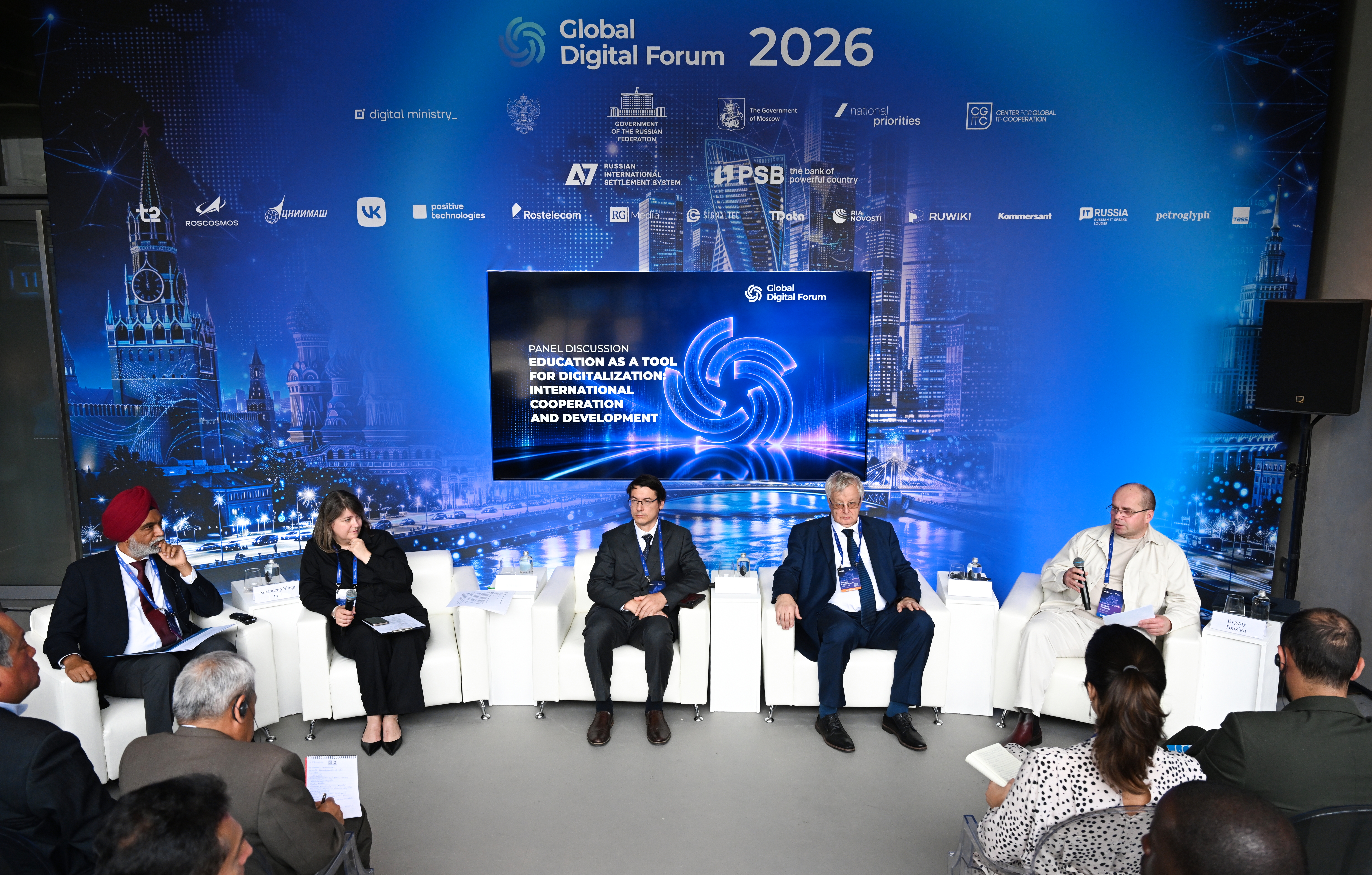
Experts from Russia and the UN discussed how education impacts the development of digital technologies at the panel discussion, Education As A Tool For Digitalization: International Cooperation And Development.
UN Under-Secretary‑General and Special Envoy for Digital and Emerging Technologies Amandeep Singh Gill called human resources the key component of digital development and highlighted three levels of training in the field of AI. The first is literacy of the entire society.
“I believe we need the entire society, especially school students and teachers, to be AI literate because teachers are even lagging behind children in understanding what artificial intelligence is,” he noted.
The second level is the use of AI in the commercial sector. Managers and employees need to be trained on how to use AI in their professional activities.
“They are not implied to develop artificial intelligence, but to be able to master and apply it,” Amandeep Singh Gill said.
The third level is the ability to embrace and integrate technologies.
“The faster the technology spreads, the greater its impact will be,” the UN special envoy added, drawing an analogy with electricity: when electric motors appeared, production processes had to be restructured.
Deputy Head of Division at the Telecommunications Research Center (Russia) Evgeny Tonkikh added that one of the key education issues deals with training personnel for digital economy.
“We expect someone to teach us. But who is going to teach teachers? It’s important to train not only consumers, but also those who teach us. This is especially important for developing countries,” he emphasized.
He believes it is necessary to create a system not only for those who are just entering the market, but also for those who are already working and need to requalify.
Head of Research Area at the Skolkovo Institute of Science and Technology, Professor Ivan Tyukin noted that the world has changed radically, and education is not just lagging behind — it is “one kilometer behind” the developments.
“The education system must move from a place where knowledge is simply transmitted to a method where creators are brought up, and teachers must be practicing scientists themselves,” he said.