

Digital transformation is reshaping healthcare worldwide. Care is increasingly shifting toward prevention: artificial intelligence, big data, telemedicine, wearable devices, and personalized medicine platforms are opening new doors for early risk detection and proactive health management.
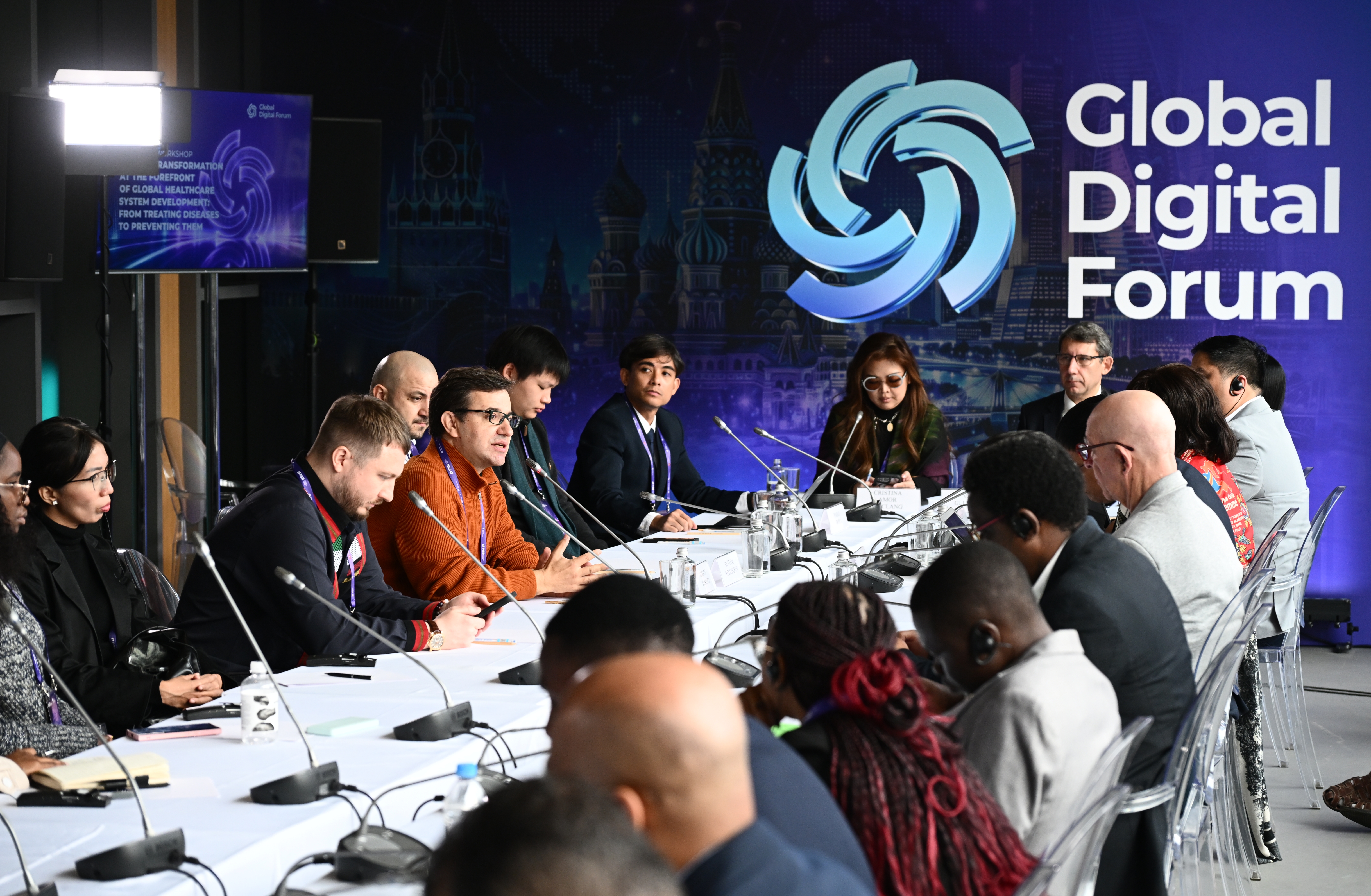
How digital technologies can transform healthcare, and which digital prevention models have already proven their worth, was the focus of the workshop Digital Transformation at the Forefront of Global Healthcare System Development: From Treating Diseases to Preventing Them.
Rustam Yerizhokov, Head of the Research Department for Standardization and Quality Control at the Center for Diagnostics and Telemedicine, shared insights on the use of AI in Russian healthcare. He described a six-year experiment in Moscow showing how technology and artificial intelligence can help doctors interpret diagnostic studies faster. Over that period, AI tools were tested across more than 45 clinical specialties.
“We have even seen the emergence of mandatory specialized insurance protocols that incorporate the use of artificial intelligence by physicians,” Yerizhokov reported.
According to Yerizhokov, the project was scaled up nationwide after 2024, following a decision by President Vladimir Putin. Today, more than 2,400 medical organizations across 70 regions of the country use the AI-enabled services developed in Moscow. The system now processes approximately 1.1 million tests a month across six clinical specialties.
“In our view, most promising use of AI, in our view, is in the triage and subsequent autonomous reporting of studies with no signs of pathology,” the expert said.
He also noted that AI’s established applications include drafting preliminary reports to help radiologists avoid errors; performing automated measurements (morphometry); opportunistic screening; and providing a “second read” for results from mass preventive screening programs.
Paolo Borja, co-founder of Bio-T, a Philippine developer of diagnostic solutions, believes public demand for disease prevention and early detection is growing year by year.
“We are moving to a new level in medicine – a proactive one,” Borja noted.
He placed particular emphasis on transparent management of AI tools and the clear benefits they offer users. Paolo Borja called for seamless integration with existing, traditional clinical tools.
Lane Guolan Chen, founder of 2Health AI Limited, raised a critical issue facing the global medical technology community: who bears responsibility when AI makes an error in interpreting medical scans?
“We trust a doctor, even though they might make a mistake. They have extensive experience, knowledge, and a reputation. So can we trust AI? We need a very carefully developed standard for medical AI tools,” said Lane Guolan Chen.
In his view, AI should remain an assistant, but its specific role within the clinical workflow must be clearly defined.
“It does an excellent job as an assistant – performing a sort of audit – but the final decision is made by the doctor, and the doctor bears the responsibility for that decision,” he concluded.
Rama Prasad Varanasi, CEO of Regenerative Futures, addressed the question of establishing ethical and legal frameworks for health data as medicine shifts to a proactive model.
“Where do we draw the line on confidential information? Can we equate medical record data with passport details? Where will medical data be stored? We need to resolve many of these questions together, at the intersection of national sovereignty and international cooperation,” Varanasi noted.
Bénie Koy, co-founder of Women in Tech DRC (Democratic Republic of the Congo), emphasized that in a number of African countries, it is necessary to engage not only technical specialists in the medical field but also experts on tropical diseases.