


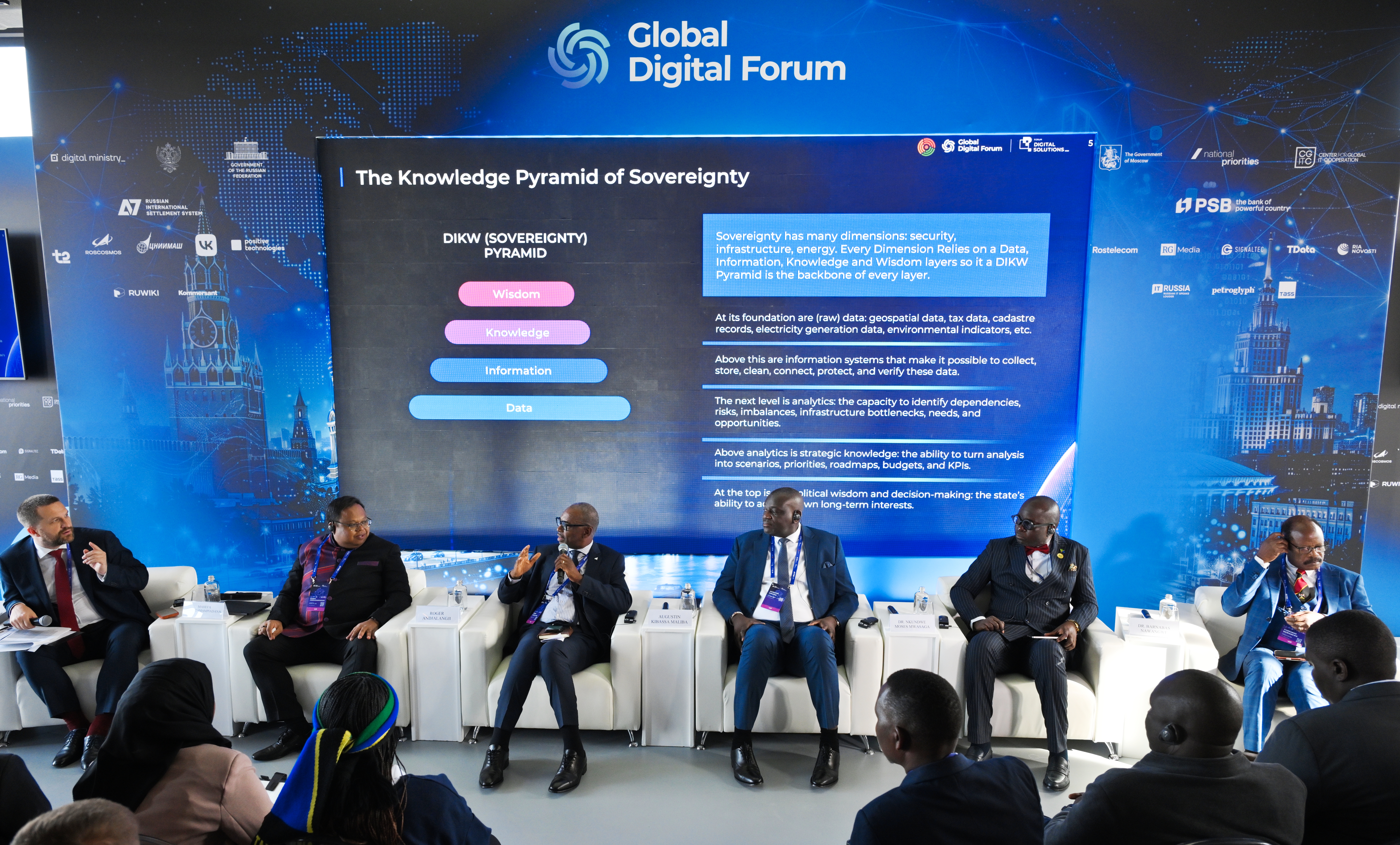
Several key trends have emerged regarding digital sovereignty that are now driving the development of the digital industry: sovereignty in data storage, cybersecurity, infrastructure, and energy. Experts discussed these issues during the round table, Practices of Implementing Digital Sovereignty: National Strategies, Legislation, and Global Experience.
According to Mahefa Andriamampiadana, Minister of Digital Development, Digital Transformation, Posts, and Telecommunications of the Republic of Madagascar, digital sovereignty does not mean self-sufficiency, nor is it equivalent to isolation.
Meanwhile, Roger Andjalangji, Minister of Digital Economy, Posts, and Telecommunications of the Central African Republic, noted that the country is now working to establish data centers to store data on its own servers.
“At the same time, it is crucial to cooperate with certain countries, particularly Russia. This is essential for storing data locally. This is not only an element of sovereignty but also of national identity,” the minister stated.
According to Augustin Kibassa Maliba, Minister of Digital Economy of the Democratic Republic of the Congo, in the field of artificial intelligence, it is crucial to understand how to manage AI workflows and how to store, transmit, and use data.
“AI is the defining issue of the day. We believe it is, of course, an engine of transformation for nations,” he remarked.
Barnabas Nawangwe, Vice Chancellor of Uganda’s Makerere University, added that certain risks stem from the fact that the university’s research is published on foreign platforms, meaning intellectual property must therefore be protected.
“The most up-to-date information we receive must be fully secured against any potential compromise. Naturally, this requires significant investment to ensure the resilience of these systems based on data centers,” the expert explained.