

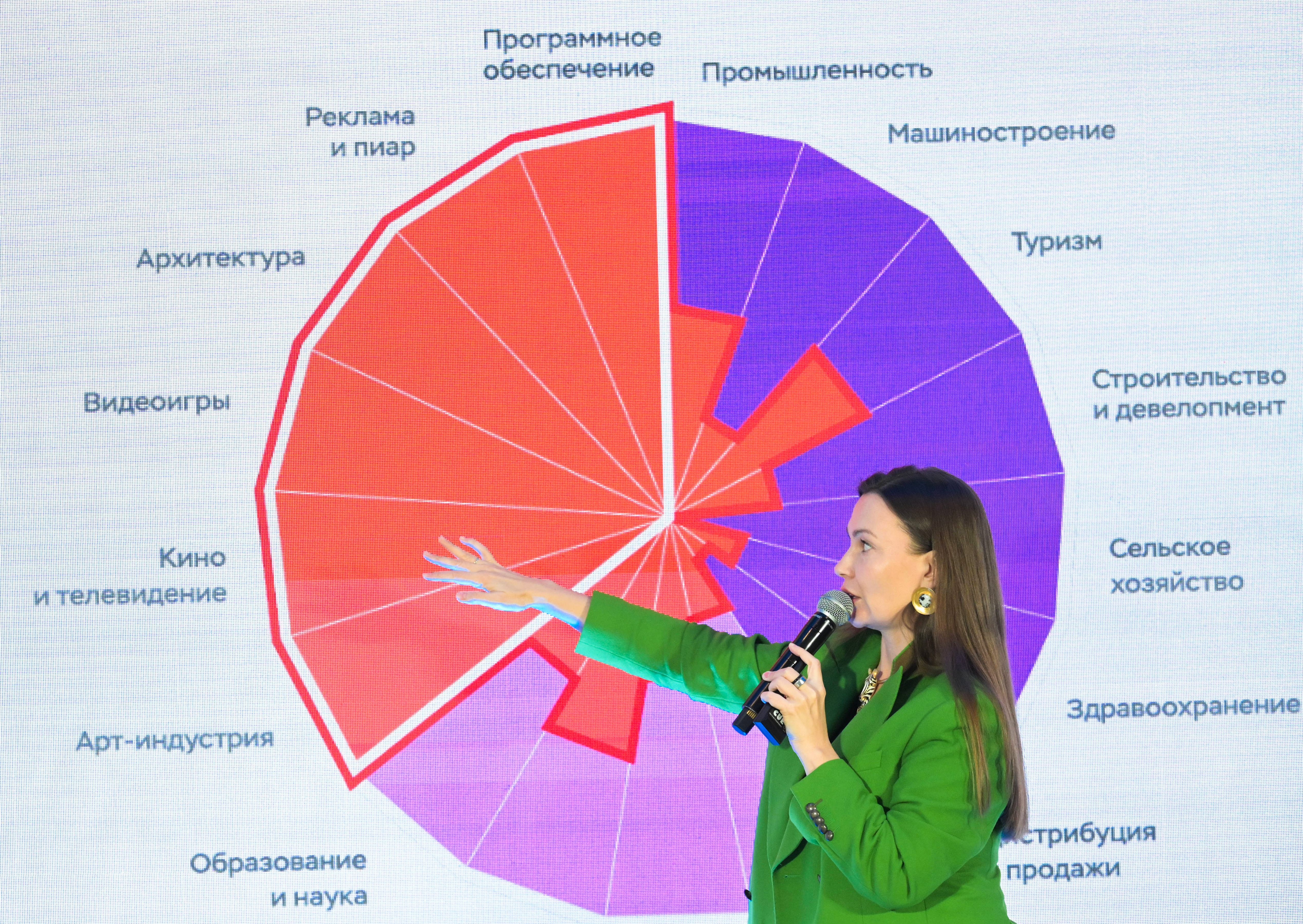
Russia’s creative economy is a fast-growing sector in which intellectual property, ideas, and human talent, rather than natural resources, are becoming key strategic assets. President of the Unified Center for the Creative Economy (the Creative Economy Autonomous Nonprofit Organization) Marina Mongush discussed this in greater detail in her visionary lecture.
She noted that Russia had adopted a federal law on the development of creative industries two years ago, providing greater legal clarity for businesses and regulators.
Marina Mongush highlighted the key principles of Russia’s creative economy: decentralization and respect for people. She stressed that a product’s value is not measured by how much money it earns its producers, but by how many people it helps become better. In her view, this is what distinguishes Russia’s approach to developing the creative economy from the Western model.
“US economist and sociologist Richard Florida argued that the creative class is a privilege enjoyed by large cities,” she said. “The creative economy lives, evolves, and creates in a metropolitan environment. The Western model of the creative economy is based on centralization, because its primary objective is to accumulate capital.”
Marina Mongush noted that Russia’s creative economy is growing nearly four times faster than the national economy as a whole. In 2019, there was only one development institution for creative industries; by 2026, there were 53. Seven years ago, there were no creative industries schools. Today, 135 such institutions operate in 69 regions. Russian universities offer 1,200 departments and educational programs in the field.
“There was a time when the word ‘marketing’ did not exist,” the expert said. “This practice was introduced relatively recently, and now it is commonplace. The same is true of creative industries and the creative economy. Until recently, we did not understand what this term meant, but today it is becoming a new wave.”
Marina Mongush also cited the results of a survey conducted by the Russian Public Opinion Research Center (VTsIOM), according to which 81 percent of Russians believe that developing creative industries in the country is important.